

A filter that doesn’t fit isn’t a saving. For the Bidet Seat Water Filter - Ion, a bidet water filter replacement uses 1/2-inch fittings, one male and one female, and the listed replacement interval is 4-6 months. The cost depends on the filter type and how it’s sold, while compatibility comes down to matching the fittings to your water connection.
It’s reasonable to want a clear price before replacing a filter, but the right fit matters just as much. A mismatch can complicate installation or make the filter unsuitable for your setup. The Ion filter is designed to reduce sand, dirt, rust, and other particles in incoming water that may damage bidet seats.
This guide explains how to compare fittings and connections, what can affect replacement cost, and which particles a filter is designed to reduce. You’ll also learn when replacement may be due so you can make a practical choice for your toilet and water line.
Key Takeaways
- Match the filter’s fitting type to the connection on your toilet’s water supply line before choosing a replacement.
- Replacement cost depends on the filter selected and how it’s sold, so compare compatible options rather than price alone.
- Learn which incoming-water particles a filter is designed to reduce and why that matters for bidet seat care.
- Use the recommended replacement interval as a maintenance guide, and consider your water line setup when planning the change.
- Explore bidet seats, toilets, and combinations to find an option that fits your bathroom and daily needs.
Filter fitting size and installation
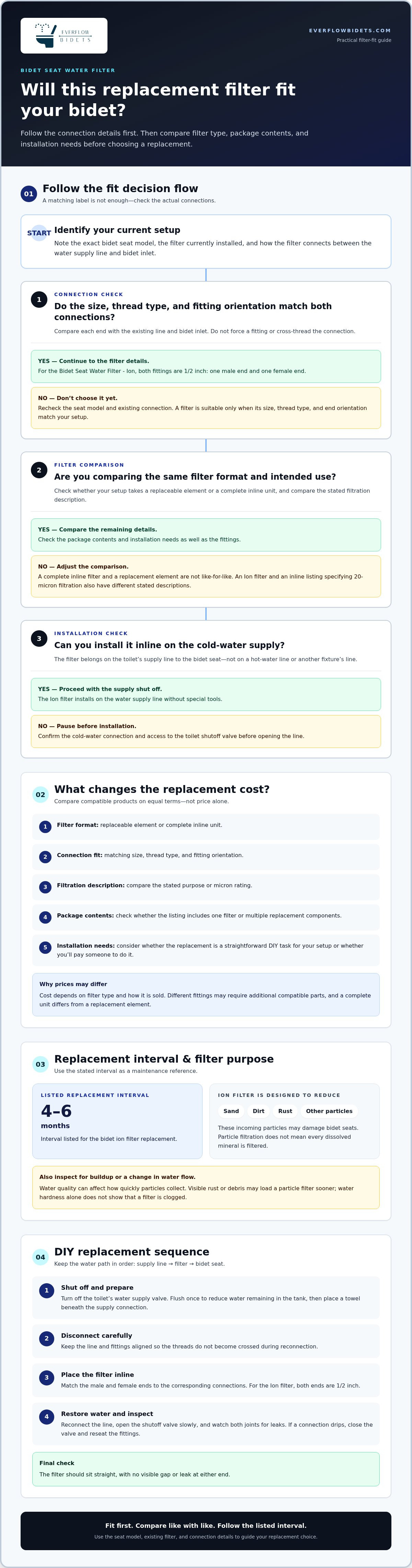
Match the filter’s fittings to the water line and bidet connection before installation. For the Bidet Seat Water Filter - Ion, both fittings are 1/2 inch, with one male and one female end.
Plan a cold-water-only installation, and shut off the toilet’s water supply before opening the connection. For a careful DIY replacement, follow the water path: supply line, filter, then bidet seat.
Universal and Third-Party Compatibility
Universal and third-party filters can fit a bidet when their connection size, thread type, and fitting orientation match the seat’s water line. Two examples are an Ion filter with 1/2-inch male and female fittings, and an inline filter listing that specifies 20-micron filtration. Their specifications differ, so compare the filter’s stated use and connection details before selecting one.
A filter’s label alone doesn’t establish compatibility. Check that the fitting on each end connects to the existing line and bidet inlet without forcing or cross-threading. A universal filter is useful only when its connections suit your particular setup.
Brand and Model Fit
For popular brands such as TOTO, Bio Bidet, Horow, and Cascade, choose a replacement based on the exact bidet seat model and water connection. The brand name alone won’t identify a matching filter: seats within one brand can have different connection arrangements.
Record the seat model, then compare the replacement’s fitting size and male or female orientation with the existing connection. This helps narrow your options without assuming that one filter fits every model.
For a DIY change, prepare the new filter, a towel, and access to the toilet’s shutoff valve. The Ion filter installs on the water supply line without special tools. Keep the work on the cold-water connection, not a hot-water line.
- Turn off the toilet’s water supply valve. Flush once to reduce water remaining in the tank, then place a towel beneath the supply connection.
- Disconnect the supply line carefully. Keep the line and fittings aligned so threads don’t become crossed during reconnection.
- Install the filter in the water path, matching its male and female ends to the corresponding connections. For the Ion, the two ends are 1/2 inch.
- Reconnect the line, open the shutoff valve slowly, and watch the joints for leaks. If a connection drips, close the valve and reseat the fittings.
Cold-water-only installation matters because the toilet supply connection feeds the bidet seat. Keep the filter inline on that supply, rather than placing it on another bathroom fixture’s line. After restoring the water, inspect the filter joints while the line is pressurized. The filter should sit straight, with no visible gap or leak at either end.
Types differ by design and stated filtration details. The Ion filter is described as adding ions to the water stream and reducing incoming particles; a smart-toilet inline filter listing specifies 20-micron filtration. These descriptions aren’t interchangeable, so compare intended use and connections, not just filter terminology.
Bidet filter replacement price
Replacement cost depends on the filter design, connection compatibility, and packaging. Start by identifying the exact filter type your bidet requires, then check whether the replacement is a filtering element or a complete inline unit. Don’t compare products by price alone when their fittings or intended uses differ.
For a bidet water filter replacement, first identify the seat model and the filter currently installed. Compare the replacement’s fittings, filtration description, and package contents. These details help distinguish a compatible option from a similar-looking filter intended for another setup. Installation may also affect the total cost if you pay someone to do the work instead of handling it yourself.
A practical comparison checklist keeps the decision focused:
- Filter format: Determine whether your setup uses a replaceable element or a complete inline filter.
- Connection fit: Match the fittings and orientation to the existing supply line.
- Filtration description: Compare the stated purpose, such as particle reduction or a specified micron rating.
- Package contents: Check whether the listing includes one filter or multiple replacement components.
- Installation needs: Consider whether the change is a straightforward DIY task for your setup.
These factors explain why two filters can have different prices without being direct substitutes. A filter with different fittings may require additional compatible parts, while a complete unit differs from a replacement element. Compare like with like: the same purpose, compatible connections, and similar contents. Keep the existing filter or its packaging nearby while reviewing product details.
How do you know when a bidet filter needs replacing? A replacement listing for a bidet ion filter gives an interval of 4-6 months. Reduced water flow or visible debris may also prompt inspection, but the interval provides a clear maintenance reference.
Water hardness and local water quality can affect how quickly particles collect, but hardness alone doesn’t show that a filter is clogged. A filter designed for sand, dirt, rust, and other particles addresses sediment, not every dissolved mineral. Water with visible rust or debris may load a particle filter sooner than cleaner water. Follow the filter’s stated interval and inspect for buildup or changes in water flow.
Before purchasing, write down the model, fitting details, and current filter type. Compare those details against each replacement listing, then weigh the full package and installation needs. If you’re planning a broader bathroom update alongside routine filter care, explore bathroom upgrade options that suit your space.
Contaminants reduced by the filter
A bidet filter can reduce particles carried through the toilet’s incoming water line. The Bidet Seat Water Filter - Ion is designed to remove sand, dirt, rust, and other particles that may damage bidet seats. Knowing what it is designed to do helps set realistic expectations.
What happens if you use a bidet without replacing its filter? Without a working particle filter, sand, dirt, rust, and similar debris may reach the bidet seat. These particles can pose a risk to the seat, which the filter is designed to help protect.
These examples clarify the filter’s intended role:
- Sand: Small grains can travel with incoming water and enter the seat’s water pathway.
- Dirt: Loose particles may collect in the supply path rather than disappear on their own.
- Rust: Discolored or rust-bearing water can carry particles toward the bidet connection.
- Other particles: The Ion filter is designed to reduce additional incoming debris that may affect the seat.
Some inline filter listings describe a 20-micron rating. A micron is a unit used to describe particle size; the rating helps readers compare filter specifications. It doesn’t, by itself, establish that every filter removes the same contaminants or performs identically. Read the stated filtration purpose alongside the fitting details.
The Ion filter also adds ions to the water stream to discourage bacteria and improve hygiene. This feature differs from the stated particle-reduction purpose. Don’t treat particle filtration as proof that a filter removes every dissolved substance or makes water sterile.
To judge a filter’s scope, read its description for named targets such as sand, dirt, and rust. Then compare any rating, such as 20 microns, with the filter’s stated purpose. These details explain what the product is designed to address, not every possible condition in household water.
During inspection, look for visible debris or rust-colored residue on the filter body and nearby connection. These signs may point to particles in the supply path, but appearance alone won’t identify every contaminant. Keep the replacement interval in mind and use the filter’s stated specifications to select a matching unit.
A filter is one protective step between the water supply and the bidet seat. It doesn’t replace understanding the water entering your home. If you’re concerned about a substance beyond sand, dirt, rust, or other particles, compare it with the filter’s stated reduction claims before relying on the filter.
Filter connection size
Connection size is only one part of a compatible replacement. The shape of each end, thread arrangement, and direction of water flow also matter. Compare the existing assembly with the replacement’s written specifications instead of choosing by appearance alone. A filter that looks close may still fail to connect cleanly to the supply line or bidet inlet.
Start by identifying the two connection points around the existing filter. One side leads toward the toilet’s supply; the other continues to the bidet. Note how each fitting joins its neighboring part and whether the filter body has a flow-direction marking. If the replacement lists an inlet and outlet, match those labels to the same path.
Use these checks to assess the connection before purchase:
- Read the filter label or product documentation for its stated connection size and thread details.
- Inspect both ends separately. Record the shape and orientation of each fitting, not just the overall filter size.
- Compare those details with the existing line and bidet inlet. The two ends may need different orientations.
- Look for a flow arrow or inlet marking on the replacement, then compare it with the water path.
- Review whether the replacement is intended to connect directly or needs a compatible adapter.
Measurements taken from the outside of a fitting can be misleading because the listed connection size may refer to its nominal designation. Use printed specifications or model documentation whenever possible. If the existing line’s label and the replacement listing use different descriptions, compare the thread type and connection design before treating them as equivalent.
Adapters can bridge compatible differences, but they add another connection point, so the fit and alignment of each joint matter. Don’t stack parts simply because their ends can be joined: every component must suit the water line and bidet connection. A bent or strained assembly can make future filter changes harder.
During a dry fit, bring the parts together gently and keep them aligned. Threads should engage cleanly, not catch at an angle. If the connection binds immediately, stop and reassess the size or thread arrangement instead of forcing it. Check that the filter body has room to sit without pressing against the wall, toilet, or nearby plumbing.
Before finalizing your choice, record the seat model, filter markings, connection descriptions, and any flow-direction label. These details make future replacement decisions clearer, especially if the original packaging is gone. A precise match depends on the complete connection arrangement, not one measurement or the filter’s general appearance.
How often should you replace a bidet water filter?
Follow the replacement schedule provided for your specific filter, and record each change to keep maintenance predictable. Different filter designs may have different care instructions, so don’t assume one model’s schedule applies to another. Keep the product name and installation date together in a bathroom maintenance note or household calendar.
A simple record can prevent uncertainty later. Write down the filter model, installation date, and source of its care instructions. If another household member handles maintenance, the record makes the next replacement easier to plan. Save the packaging or take a clear photo of its label before discarding it.
Use this routine to keep your maintenance records useful:
- Record the model: Note the filter name and any identifying information from its label.
- Save the instructions: Keep the replacement guidance with your household maintenance records.
- Log each change: Add the installation date after every replacement.
- Plan ahead: Keep the correct filter details accessible before the next scheduled change.
- Review the record: Compare the current filter with your notes before purchasing another.
When the replacement date approaches, use your records to prepare rather than waiting until the filter is removed. Check that you still have the model information and instructions needed for the change. If you’ve changed the bidet seat since the last replacement, update the record to reflect the new equipment.
Household routines can make filter maintenance easier to remember. Add it to the home-care list you use for other bathroom upkeep, or set a reminder in a shared calendar. A note with the toilet’s maintenance records can also help, especially when several people look after the bathroom.
After changing the filter, update the date and keep the product details. This gives you a clear starting point for the next maintenance cycle and helps prevent confusion between filter models. Don’t rely on memory alone, particularly if a fixture has changed or the product packaging is no longer available.
If you’re reviewing your bidet setup as part of a broader bathroom update, consider how the seat and its ongoing care fit your routine. Comparing bidet toilet seat options can help you assess which format suits your bathroom and maintenance preferences. A clear record and a suitable setup make routine care easier to manage.
EverFlow Bidets: Bidet Toilets
EverFlow Bidets sells bidet toilets, bidet toilet seats, and bidet toilet combinations for homeowners considering a broader bathroom upgrade. Filter maintenance can also be a useful time to review your setup: keep the current toilet and water connection, or explore a different bidet format that better suits your space and daily preferences.
A bidet toilet seat works with a compatible existing toilet, while a bidet toilet or combination can be part of a more complete fixture change. Compare the options with your bathroom layout and personal hygiene preferences in mind. Filter fit remains specific to the chosen model and its water connection.
For product options and guidance as you consider your next step, visit EverFlow Bidets.
Make Your Next Bathroom Decision With Confidence
A filter change can prompt you to think beyond routine maintenance. Consider how your bathroom needs may evolve, whether your current setup remains comfortable to use, and what you’d value in a future upgrade. For readers looking to upgrade daily personal care through science-focused health solutions, brands like Novoflö offer thoughtful approaches to everyday wellbeing. A bidet water filter replacement is one small part of ownership: a dependable fit, straightforward care, and a bathroom that supports your daily routine.
If you’re weighing a new bidet setup, consider the toilet, water connection, and intended use. EverFlow Bidets offers options to explore and can help you find a direction that fits your priorities. Take the time to understand what matters in your space before making a practical next choice.
Contact EverFlow Bidets for help as you consider your next step. Thoughtful choices now can make everyday care feel simpler and more comfortable.
Frequently Asked Questions
How do you replace a bidet water filter step by step?
Use the bidet seat’s model-specific directions, and document the existing setup before removing anything. Photograph the filter orientation and keep washers or seals in order as you remove parts. Install the replacement according to the directions, then run a short bidet cycle and inspect the assembly. If the seat’s instructions differ from a general guide, follow the model instructions. This record can help with later maintenance.
How much do bidet replacement filters cost in the United States?
Use the current listing amount for the exact replacement item you plan to buy. For your household records, save the receipt with the filter model and purchase date. This creates a product-specific reference for future budgeting, rather than relying on an old screenshot or an unrelated filter’s advertised amount. At checkout, record the final total alongside the item price.
Does a bidet filter remove chlorine, sediment, or bacteria from tap water?
A filter’s general description doesn’t establish that it reduces chlorine, sediment, and bacteria alike. Match water-quality concerns to explicit claims for each named substance, and don’t treat ion addition as proof of bacteria removal. If you have water test results, compare the named findings with the filter’s specifications. Don’t extend a claim about one target to other substances.
Disclaimer
The information provided in the EverFlowBidets blog is for general informational and educational purposes only. While we strive to publish accurate, current, and well-researched content, nothing on this website should be considered medical advice, diagnosis, or treatment. Articles discussing the potential health, hygiene, accessibility, or environmental benefits of bidet use are based on publicly available research, manufacturer information, and other reputable sources. Individual results may vary, and any health-related decisions should be made in consultation with a qualified healthcare professional.